A new car does not automatically need abrasive polishing. If the paint is clean, free of defects you want corrected and ready for the chosen protection system, cleaning and protection may be enough. Decide from the actual finish, its treatment history and your expectations rather than the vehicle’s age or a standard detailing package.
Some new cars do arrive with contamination, light wash marks or other delivery issues. That is a reason to inspect and identify the problem. It is not a reason to compound every panel by default.
This guide is for conventional gloss automotive paint. Matte or satin finishes, wraps, paint protection film, existing coatings and recently repaired panels require their own instructions before any abrasive work.
New Does Not Describe the Paint Condition
A newly delivered vehicle may have been transported, stored outdoors, washed or prepared before handover. These steps can leave different issues, and each needs a different response.
Dust and road film are cleaning problems. Bonded particles may require suitable decontamination. Fine wash marks may be candidates for mild correction if the benefit justifies it. A deep scratch, unusual patch or possible repair issue needs a separate assessment.
It is also possible for a new car’s paint to look good enough without correction. Do not search for a reason to remove material simply because a polisher is available or a protection package includes the service.
Start with a Delivery and Treatment Check
Before working on the paint, record its condition and clarify what has already been applied. If you notice a delivery concern, photograph it and raise it with the seller before trying to correct it yourself. This preserves a useful record of the original issue.
Ask for practical information:
- Has the vehicle received dealer-applied wax, sealant, coating or film? Which product or system?
- Are there known panel repairs or refinishing, and what care instructions apply?
- What preparation does the proposed protection product require?
- Does any supplied care plan or warranty specify approved maintenance?
An invoice saying “paint protection” may not explain whether the surface has wax, a coating or film. Identify the actual treatment before adding another product or using an abrasive.
Inspect After a Careful Wash and Dry
Loose dirt can hide defects and can also create new marks if you rub it around. Use a finish-compatible wash method and clean drying materials before judging the surface closely.
Inspect under diffuse light for overall consistency, then use a suitable inspection light to reveal fine marks. Look across different panels rather than judging only the centre of the hood. Do not rub dry dirt or use an aggressive cleaner simply to find out whether something is a scratch.
If roughness or bonded specks remain, identify the contamination and choose an approved treatment. Meguiar’s FAQ explains that clay targets suitable above-surface contamination rather than swirl marks. Mechanical decontamination can itself leave marks on some finishes, so it should be used when justified and with the correct method, not automatically on every new car.
Use This Decision Table
| What you find | What to consider | Is abrasive polishing automatically needed? |
|---|---|---|
| Clean, clear paint that meets your expectations | Compatible protection and a careful wash routine | No |
| Road film or loose delivery dirt | Suitable washing and cleaning, then reassessment | No |
| Bonded specks or roughness | Identify the contamination; use suitable decontamination if needed | No; inspect again afterward |
| Light wash swirls on an otherwise sound finish | Decide whether mild targeted correction is worthwhile | Possibly, after a test spot |
| A deeper isolated scratch or unexplained patch | Document it and seek seller or specialist assessment | No automatic whole-car correction |
| Existing coating with changed water behaviour | Check cleaning and coating-care directions | No; water behaviour does not establish a polishing need |
| Film, matte paint or a recent repair | Obtain the specific surface or paint-system instructions | Do not apply a standard gloss-paint procedure |
The table separates three questions: what is present, what treatment addresses it, and whether removing paint material is justified. That sequence helps avoid treating contamination as if it were a correction defect.
When a Mild Correction May Make Sense
Correction may be reasonable when the finish has assessed, suitable defects that bother you and a controlled test shows useful improvement. Light wash swirls are one example, provided the paint and treatment history support the process.
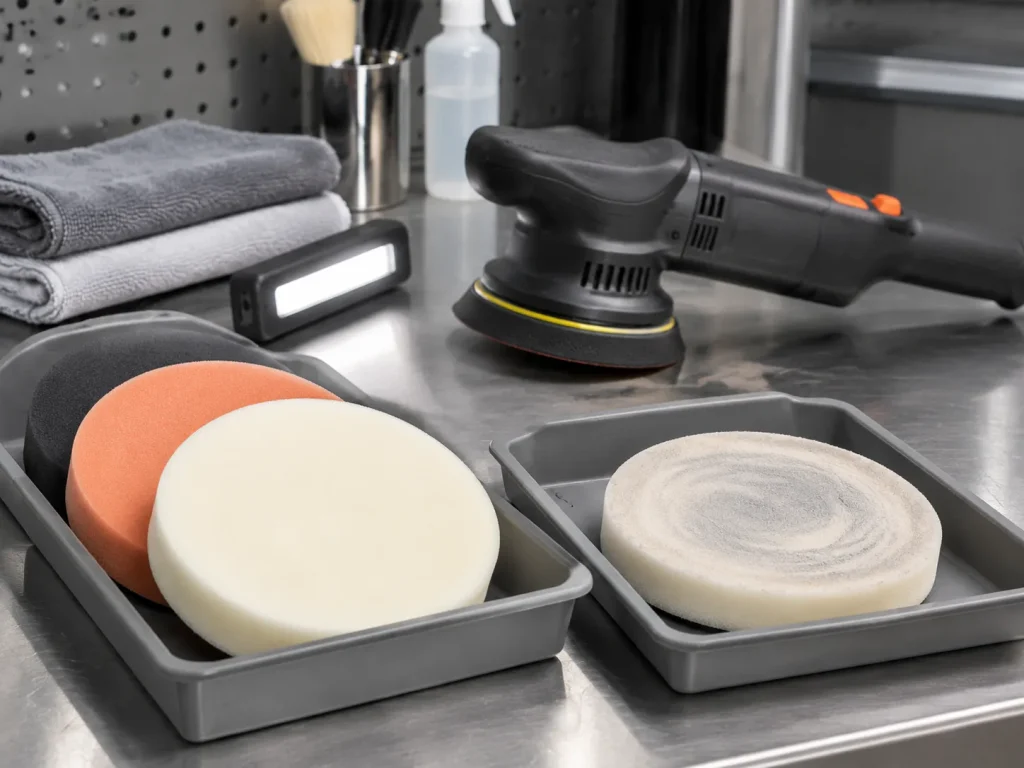
Start with a mild approved pad-and-liquid system. When reviewing polishing pads, confirm the intended task and the exact machine/plate pairing rather than buying the strongest advertised option. The Griot’s Garage G9 instructions describe assessing paint condition, using the least invasive method and testing the result. Its particular machine settings do not apply to every polisher.
A practical assessment is:
- Confirm the finish and check for existing treatments or repair restrictions.
- Wash, dry and address appropriate contamination only as necessary.
- Inspect the clean surface and set an acceptable goal.
- Test a suitable mild combination on a representative area, following its instructions.
- Remove residue using a compatible method and inspect for clarity and new marks.
- Continue only where the benefit justifies the work; leave deeper or uncertain defects for assessment.
New car paint correction does not have to mean the same treatment across the whole vehicle. A local concern may need local attention, while acceptable panels can be left alone. Do not pursue complete defect removal simply to match an idealised photograph.
Does a New Car Need Polishing Before Ceramic Coating?
The coating needs the surface preparation specified by its manufacturer. That may involve suitable washing, decontamination and a compatible preparation product. Abrasive polishing is a separate decision based on defects and the coating system’s requirements.
Correcting suitable defects before coating can improve the appearance that will remain visible afterward. But a coating does not make deep scratches disappear, and applying one is not proof that aggressive correction was necessary.
Ask an installer what they found on the paint, which correction they propose and why. An explanation tied to your actual panels is more useful than an automatic multi-stage package. Keep preparation and application within the product system rather than mixing unrelated solvent-wipe instructions.
Special Cases: Matte Paint, Film and Repaired Panels
Matte or satin paint: ordinary abrasive polishing can change the intended sheen. Use the vehicle and finish manufacturer’s care instructions and obtain an appropriate assessment for defects.
Paint protection film or wraps: the exposed surface is film rather than ordinary paint. Do not apply a standard paint-correction process. Cleaning, stain treatment and any permitted polishing must follow the specific film manufacturer’s guidance.
An existing ceramic coating: abrasive polishing can alter or remove the coating in the worked area. Establish whether you are maintaining the coating or intentionally correcting the underlying finish, and plan any reapplication accordingly.
Recently refinished panels: new vehicle delivery does not rule out repair work. Follow the paint system and repairer’s guidance for polishing, protection and curing. Do not replace that advice with a universal waiting period.
If the Paint Looks Good, Protect It and Maintain It
When cleaning reveals an acceptable finish, choose protection that suits the surface and your maintenance plan. Follow the directions for preparation, application and curing. More layers or more kinds of product do not automatically improve the result.
Keep wash media and drying towels clean, use a method appropriate to the surface and address suitable contamination promptly. These habits can reduce the marks that lead owners to seek correction later.
Inspect when you clean the car, but avoid a compulsory abrasive polishing calendar. The need depends on paint condition and history. A new car does not need to be polished now to qualify for good maintenance later.
If an assessed correction task does require a machine, our DA vs rotary guide explains the drive types. Review FineBuff DA models using their approved specifications and accessory information; owning a particular machine does not establish a need to polish. If your practical question is access to mains power or working around the vehicle, our corded vs cordless guide covers that equipment decision separately from the paint-care decision.
Frequently Asked Questions
Should I polish a brand-new car immediately?
Only if inspection identifies a justified correction need and the surface allows it. Clear, suitably clean paint can often move straight to compatible protection without abrasive polishing.
Will polishing damage new car paint?
Abrasive polishing removes material and can cause damage when the process is unsuitable. Newness does not remove the need for surface identification, an approved system and a test spot.
Do I need to clay a new car?
Not automatically. Assess bonded contamination after washing, then use a finish-compatible method if needed. Clay is not a swirl-removal step and may leave marks on some finishes.
Can I wax a new car without polishing it?
Yes, when the wax is approved for the surface and the paint is appropriately clean and compatible with existing treatments. Follow any specific instructions for repaired panels or existing protection.
How long should I wait before polishing a new car?
Do not use one waiting period for every vehicle. Check the actual paint, treatment and repair history. Recently refinished panels require the paint system and repairer’s guidance; a delivery date alone cannot settle the question.
Does every new car need a two-stage correction before coating?
No. The need for correction and refinement depends on assessed defects, the tested result and the selected coating system. A sound finish may need preparation and protection without a multi-stage abrasive process.
Sources and Further Reading
- Griot’s Garage G9 instruction manual — paint assessment, least-invasive testing and equipment-specific operating guidance.
- Meguiar’s: Official Paint-Care FAQ — surface preparation, bonded contamination and the difference between cleaning and swirl correction.
These are manufacturer references. Their model settings and product-specific claims do not establish FineBuff specifications or universal results.