The main difference between polishing and waxing a car is their purpose. Abrasive polishing reduces suitable paint defects by removing some surface material. Waxing adds a sacrificial layer of protection. You can wax clean paint without polishing it first, and a conventional correction polish does not automatically leave protection behind.
If the paint already looks clear and meets your expectations after washing, you may only need cleaning and suitable protection. If it has visible swirls or dullness, first identify the cause, then decide whether correction is worth doing. A complete detailing session does not have to include every possible treatment.
This guide covers intact, conventional gloss automotive paint. Matte or satin finishes, wraps, paint protection film and repaired panels require their own care instructions.
What Each Treatment Actually Does
Car-care names can be confusing because “polish” sometimes describes an abrasive, a glaze, or a product that also contains wax. Read the intended use and directions rather than choosing by the largest word on the bottle.
| Treatment | Main job | What it does not establish |
|---|---|---|
| Washing | Remove loose dirt and road film | That bonded contamination or paint defects are gone |
| Suitable decontamination | Remove identified bonded contamination | That swirls have been corrected |
| Abrasive polishing or compounding | Reduce appropriate defects by removing material | That missing paint has been replaced or protection added |
| Glaze or filler product | Temporarily reduce the visibility of some marks | That the underlying defects have been removed |
| Stand-alone wax or sealant | Add a protective layer and affect appearance or water behaviour | That scratches have been corrected |
| Cleaner wax or all-in-one product | Combine some cleaning, possible correction or filling, and protection | That it is non-abrasive or suitable for every finish |
On a clear-coated vehicle, abrasive correction acts on the clear coat. It can reduce suitable shallow defects, but chasing a deep scratch may remove more material than the finish should tolerate. Wax sits above the surface; it cannot rebuild a damaged clear coat.
Why Both Can Make Paint Look Shinier
Polishing can improve clarity by reducing appropriate surface defects that scatter light. Wax can change the appearance of a clean finish and temporarily soften the visibility of fine marks, depending on the formula. These are different routes to a better-looking surface.
A glossy finish immediately after treatment is not proof that every mark has been removed. Oils, fillers and lighting affect what you see. When evaluating correction, remove residue using the product system’s approved method and inspect under useful lighting. Avoid an improvised strong solvent wipe, especially on an unfamiliar finish.
Likewise, strong water beading does not measure paint thickness or prove that the paint needs no cleaning. Reduced beading alone does not mean the car needs abrasive polishing.
Decide from the Paint Condition
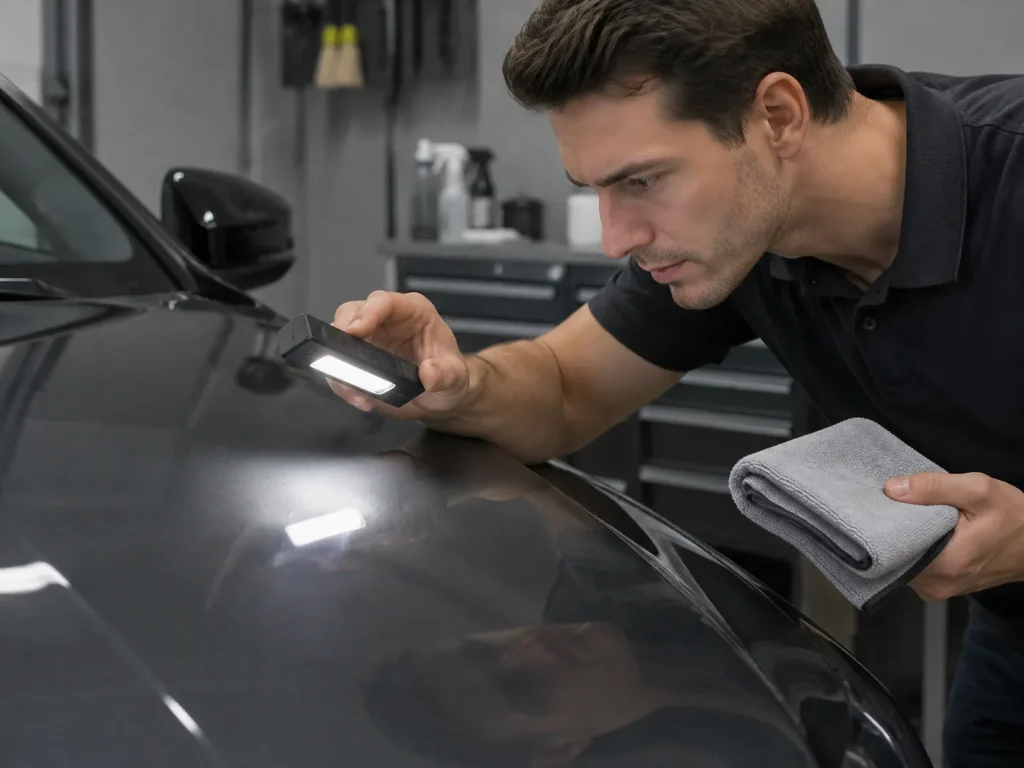
Start with a careful wash and dry. Inspect in diffuse light for overall appearance and with a suitable inspection light for marks. Judge the finish you actually have, rather than following a package that automatically includes compounding.
| What you notice after cleaning | What to consider next |
|---|---|
| Paint looks clear, feels clean and meets your expectations | Apply or maintain compatible protection if needed; skip correction |
| Roughness or bonded specks remain | Identify the contamination and choose a finish-compatible removal method |
| Fine wash swirls remain | Decide whether they justify a mild correction test; also improve washing and drying |
| Dullness remains after suitable cleaning | Assess whether it is residue, contamination, repair-related damage or a correctable defect |
| One isolated deep scratch is visible | Assess that scratch separately; do not repeatedly cut the whole panel |
| Clear coat is peeling, cracking or failing | Obtain a repair assessment; wax and polish will not rebuild it |
Meguiar’s paint-care FAQ distinguishes bonded contamination from swirls: clay is intended for suitable above-surface contamination, rather than swirl removal. That distinction helps prevent using the wrong treatment for the problem. Decontamination is also a separate decision, not a requirement to clay every car before every wax application.
Should You Polish Before Waxing?
Only when there is a justified correction need. Stand-alone wax needs an appropriately clean, compatible surface. That does not mean the surface must be freshly abraded.
If your car looks good after washing and any necessary decontamination, follow the wax manufacturer’s preparation directions and protect it. If an existing coating or sealant is present, check whether the proposed wax is compatible and whether a topper is useful at all.
When correction is appropriate, the usual order is:
- Wash and dry. Remove loose dirt before further contact with the paint.
- Address contamination if necessary. Use a method suited to the finish and the contamination; inspect again afterward.
- Perform a test spot. Start with a mild, approved pad-and-liquid combination on a representative area.
- Correct only as far as justified. Inspect the result and avoid repeatedly chasing deeper marks.
- Remove residue and prepare for protection. Use the selected protection system’s instructions.
- Apply the chosen protection. Follow its application, removal and curing guidance.
Polishing after waxing usually disturbs or removes the protection in the worked area. Adding more products in a different order does not necessarily improve durability or appearance.
Do You Need a Machine for Both Jobs?
Many waxes can be applied by hand. Some allow machine application with an appropriate applicator, but check the directions before assuming that any polishing pad is suitable. A cutting pad is not the default tool for spreading a stand-alone wax.
Machine correction requires a compatible machine, backing plate, pad and liquid. For a beginner comparing drive types, our dual action vs rotary guide explains the main differences. Even a DA machine can damage paint when the combination or technique is unsuitable.
When comparing FineBuff DA polishers, confirm the individual model’s approved accessories and instructions. Machine speed, pressure, working cycle and battery combinations must come from the relevant equipment and product documentation.
The Griot’s Garage G9 instructions provide a useful general principle: assess the paint, choose the least invasive method and test it. Their numerical settings and accessory recommendations apply to that equipment, rather than every DA polisher.
What About Cleaner Wax and All-in-One Polish?
A cleaner wax or all-in-one product can be useful when its stated combination of functions matches the task. Some products clean, refine, fill and leave protection in one application. Others emphasise only some of those functions.
Before using one, check:
- Whether it contains abrasives and is approved for the finish.
- Whether its improvement relies partly on fillers.
- Whether it actually leaves protection, and what maintenance it requires.
- Whether it is compatible with the machine, pad and any existing surface treatment.
A product labelled “one-step” is not automatically a wax-containing all-in-one. It may describe correction completed with one pad-and-liquid combination. The directions should tell you whether protection must follow.
Keep Protection Maintenance Separate from Correction
Inspect and maintain wax according to the product, exposure and current surface condition. Do not turn a wax-renewal reminder into a compulsory polishing appointment.
There is no universal safe polishing interval or fixed number of correction sessions for every car. The paint system, previous repairs, earlier correction and local panel condition all matter. Gentle washing, clean drying towels and prompt removal of appropriate contamination can reduce the need for future correction.
For a daily driver, a clean, protected finish with a few acceptable marks may be a sensible outcome. Removing every visible defect is not always compatible with preserving the finish.
Frequently Asked Questions
Can I wax a car without polishing it?
Yes, if the surface is suitably clean and the wax is compatible with the finish and existing treatments. Polishing is a separate correction decision, not a compulsory preparation step.
Does wax remove swirl marks?
A stand-alone non-abrasive wax does not correct swirls. It may temporarily change how visible some marks are. A cleaner wax may contain abrasives, so check the formula’s intended use.
Does polish protect paint?
A conventional correction polish should not be assumed to leave protection. Some all-in-one products do. Read the directions and apply compatible protection afterward when required.
Should I polish or wax a car that looks dull?
First wash and inspect it. Dullness can come from contamination, residue, defects or a failing finish. Choose the treatment after identifying the cause; do not automatically compound it.
Can I wax over a ceramic coating?
Follow the coating manufacturer’s maintenance guidance. An unapproved topper may change its appearance or water behaviour and may be unnecessary. Reduced beading alone is not a reason to polish the coating.
How often should I polish and wax my car?
Treat them as separate decisions. Maintain protection according to the product and exposure; consider abrasive polishing only when assessed defects justify it and the paint condition allows it.