Private Label Car Polishers: A Buyer’s Checklist
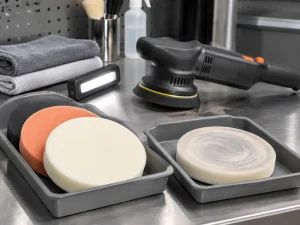
A private-label car polisher project needs more than a logo on the housing. The buyer must define the machine, supplied accessories, market requirements, packaging and approval process well enough that the sample and production order describe the same product.
The most useful starting document is a written buying specification. It gives each supplier the same questions to answer and makes differences between quotations easier to identify. Use the following checklist when preparing an RFQ, evaluating samples and agreeing the production specification.
1. Define the customer and intended application
State who will buy the tool and where it will be used. A range for mobile detailers may need different kit contents from one for fixed workshops. A retail product for mixed experience levels may require different instructions and support from a specialist professional model.
Include the destination country, sales channel, intended tasks and expected order quantity. Describe the actual applications rather than relying on broad terms such as “professional grade.” A supplier should be able to respond with a specific model and configuration.
2. Fix the machine specification
Identify the model code and drive mechanism: rotary, free-spinning random-orbital DA or forced-rotation DA. For a DA machine, specify orbit size separately from backing plate and pad dimensions.
Confirm rated electrical input, voltage, frequency, plug, speed range and what the speed unit measures. For cordless tools, add the approved battery platform, battery quantity and capacity, charger input and supplied charger model.
Record net tool weight and packed weight separately. Define whether the operating weight includes a battery or other accessories. Avoid copying a specification from a similar-looking model into the approved file.
3. Separate requested branding from confirmed capability
List the customisation you want: logo position, marking method, housing colour, labels, packaging artwork and manual language. Ask the supplier to confirm which items are available on the selected model and what each one changes commercially.
Use drawings, colour references and approved artwork files wherever possible. A screen image alone can be ambiguous. Ask whether a requested change affects materials, tooling, minimum quantity, price, documentation or lead time.
Replacing a logo is a different project from changing the housing, electronics or drive system. Describe those requests separately so that a quotation does not conceal unresolved development work.
4. Agree the complete kit and packaging
Approve a packing list with model numbers or clear descriptions for each supplied item. Include the backing plate, pads, handles, tools, batteries, charger, case and printed material as applicable.
Define retail packaging and shipping packaging separately. Confirm product labels, barcodes, language versions, carton quantities, carton dimensions and packed weight. Make sure product photography and sales copy describe the configuration customers will actually receive.
A useful RFQ separates the following decisions:
| Area |
What to define |
Approval record |
| Machine |
Model, drive, orbit, plate and electrical configuration |
Dated specification sheet |
| Branding |
Logo, colours, marking locations and artwork |
Approved drawings or artwork |
| Kit |
Every supplied accessory, battery and charger |
Itemised packing list |
| Documentation |
Destination, instructions and applicable records |
Model-specific document list |
| Commercial terms |
Quantity, price basis, payment and delivery terms |
Written quotation and order agreement |
| Quality |
Sample, inspection points and change control |
Approved reference and acceptance plan |
5. Review documents for the exact market configuration
Tell the supplier where the product will be sold and have the applicable requirements reviewed for that market. Ask for model-specific declarations, test reports, labels and instructions where required, including relevant battery and charger records for cordless kits.
Check that documents identify the supplied model and electrical configuration. A generic certificate image or a report for another tool does not establish that the ordered product meets your obligations.
Private labelling can also affect the responsibilities of the brand owner and importer. Confirm those responsibilities with a qualified compliance adviser for the destination market. Treat documentation review as part of purchasing approval rather than a task to leave until shipment.
6. Approve a reference sample and define acceptance
Evaluate the complete customer-ready kit, not only the bare machine. Check operation, handling, accessory fit, controls, packaging and the accuracy of the instructions against the intended use.
Record the approved configuration, sample identification and any outstanding corrections. If the approval sample differs from production materials, packaging or electrical components, document those differences before treating it as a production reference.
Agree which inspections will take place, how defects will be classified and how results will be recorded. The appropriate checks depend on the product and market; the acceptance plan should be written into the purchasing agreement rather than assumed.
7. Clarify MOQ, timing and commercial terms
Ask for MOQ by configuration. A standard-colour tool with a label change may have different commercial conditions from a customised housing or printed box.
Break the schedule into sample preparation, artwork approval, any development work, production, inspection and shipping. Define when each quoted lead time starts. A statement such as “30 days” is incomplete if the parties have not agreed whether it begins after deposit, artwork approval or another milestone.
Compare prices on the same basis. Confirm currency, included accessories, packaging, delivery term, named place and quotation validity. Do not treat an ex-factory price and a delivered price as equivalent offers.
8. Plan after-sales support and repeat orders
Agree the warranty scope, claim evidence, remedy and responsibility for associated costs. Ask which replacement parts are available and how cordless batteries and chargers will be supported.
For repeat orders, specify how component, artwork and packaging changes will be approved. Retain revision-controlled files so that later orders do not silently drift away from the approved product.
Common buyer questions
Can a buyer start with a small trial order?
Ask about the exact model and customisation level. Sample availability and trial quantities are supplier- and configuration-specific; a standard kit does not establish the MOQ for a custom project.
Does private label automatically include exclusive distribution?
No. Logo customisation does not create territorial or product exclusivity. Any exclusivity terms need a separate written agreement.
Should the first enquiry include finished packaging artwork?
It helps to describe the intended branding and language, but first confirm the available packaging format and required technical information. Final artwork should follow the approved specification and dieline.
Send an RFQ that suppliers can answer
Start with your destination market, customer type, required mechanism, electrical configuration, expected quantity and branding scope. Use the FineBuff product catalogue to identify candidate models, then send your private-label sourcing brief. Request confirmation of the available configuration, documentation, sample terms, MOQ and schedule for the specific project.
For model, logo, packaging and project-document questions, review FineBuff OEM / ODM · DA polisher range · request a quote.
Last updated: 12 November 2026
Corded vs Cordless Car Polishers: A Buyer’s Guide
Choosing between a corded and cordless car polisher means choosing how the tool will be powered throughout the working day. For a distributor, that decision also affects kit contents, replacement stock, shipping requirements and after-sales support.
A corded model can suit a fixed workshop with suitable power access and longer polishing sessions. A cordless model can suit mobile work or situations where cable routing is inconvenient. The better purchase depends on the complete workflow: corded tools need appropriate electrical access, while cordless tools need a workable battery and charging plan.
Compare the complete supplied kit
Two similar prices may cover very different products. One quotation may be for a bare cordless tool, while another includes batteries, a charger and a carrying case. A corded kit may include a different backing plate, pad or handle.
Ask for a line-by-line packing list before comparing prices. Identify the tool, approved plate, pads, battery quantity and capacity, charger, cable or plug, case and manual. Photographs help describe a product but should not replace the agreed packing specification.
| Buying consideration |
Corded polisher |
Cordless polisher |
| Power access |
Requires a suitable supply and cable routing |
Requires charged, compatible batteries |
| Longer sessions |
Does not require battery changes; operating limits still apply |
Depends on battery supply, charging and operating limits |
| Handling |
Assess cable movement and reach |
Assess balance with the supplied battery fitted |
| Localisation |
Voltage, frequency, plug and instructions |
Battery platform, charger input, plug and instructions |
| Replacement stock |
Relevant cables, switches and service parts |
Approved batteries, chargers and tool service parts |
| Shipping review |
Electrical product and accessory requirements |
Those requirements plus applicable lithium battery transport rules |
When corded tools fit the workflow
Corded machines are worth considering for workshops with organised working bays and access to the correct power supply. They avoid pauses caused specifically by depleted batteries, although that does not mean a tool is approved for unrestricted continuous operation.
Check cable length, cable flexibility and the position of the connection during normal use. Confirm the rated voltage, frequency and plug for the destination market. A travel adapter does not convert a machine's operating voltage or establish that it meets local requirements.
Include the full tool-and-accessory system in sample evaluation. Nameplate input power is electrical consumption, not a direct statement of pad output or correction performance.
When cordless tools fit the workflow
Cordless polishers can reduce cable management around a vehicle and support work away from a convenient outlet. Those advantages are most useful when the battery kit matches how the customer actually works.
Evaluate the machine with its intended battery fitted. A bare-tool weight does not represent the weight or balance the operator will experience. Check access to the battery release, switch and speed controls while holding the tool normally.
Also define the battery platform precisely. Similar-looking packs and matching voltage labels do not establish compatibility. Buyers should obtain the approved battery and charger combinations for the exact model rather than assume interchangeability across brands or product families.
The FineBuff Cordless DA Polisher is listed as a 20V platform. Request its current battery, charger and kit details before using that listing to prepare a customer offer.
Evaluate runtime and charging as a system
A runtime claim is useful only when its conditions are clear. Pad size, speed setting, applied load, surface, battery condition and temperature can all affect the result. A no-load demonstration is not a reliable description of a full polishing session.
Ask the supplier to specify the battery used, the operating conditions and the endpoint for any runtime figure. Confirm how charging time is measured as well. A charging arrangement that works for occasional use may not keep up with a busy workshop.
For battery energy comparisons, watt-hours are approximately nominal voltage multiplied by amp-hours. Use nominal voltage, not an unqualified marketing maximum. Even an accurate watt-hour comparison does not by itself predict tool runtime because the machines may draw different power under load.
Calculate ownership and support costs
For a cordless range, budget for the approved spare batteries and chargers customers are likely to need. Check replacement availability, warranty terms and procedures for handling battery-related problems before launch.
For a corded range, include the appropriate local electrical configuration, service arrangements and accessories. Compare complete customer-ready offers rather than bare tool prices.
If lithium batteries are included, confirm the transport requirements with the supplier and carrier for the intended shipping method and destination. Ask for applicable documentation, including the UN 38.3 test summary for the supplied battery type. Documentation must match the actual goods being shipped.
Common buyer questions
Is cordless always less powerful?
No. Power source alone does not establish performance. Compare specific models under representative working conditions using their approved systems.
Does a larger battery always solve runtime concerns?
It may add available energy, but compatibility, weight, balance and charging capacity still need evaluation. Use only battery options approved for the tool.
Is corded always cheaper?
Not in every market or kit configuration. Compare delivered, customer-ready kits and their expected support requirements.
Specify the operating day before the order
Describe the customer's working location, session length, electrical supply and need for mobility. Then define the complete kit and replacement plan. Browse the FineBuff product range or send your corded and cordless sourcing requirements to request configuration-specific information.
For model, logo, packaging and project-document questions, review FineBuff OEM / ODM · DA polisher range · request a quote.
Last updated: 12 November 2026
8mm vs 15mm vs 21mm DA Polishers: How to Choose
Choose an 8mm, 15mm or 21mm DA polisher by matching the complete machine, approved pad system and orbit clearance to the panels you work on; a larger orbit does not guarantee faster or safer paint correction.
8mm, 15mm and 21mm: a practical comparison
The orbit values below come from the linked FineBuff product listings. The suggested evaluation areas are selection guidance, not measured performance results or a ranking of the machines. Confirm the current specification before ordering.
| Listed orbit and model source |
What to evaluate |
What still needs confirmation |
| J05102 · 8mm |
Short-throw handling across varied panel shapes. Check the full tool size rather than assuming the shorter orbit means a smaller head. |
Head clearance, approved plate and pad, drive mechanism, electrical configuration and supplied kit. |
| J0592 · 15mm |
A candidate for mixed-panel work. Compare control on doors, curved panels and transitions rather than approving it from one flat area. |
Balance, approved pad system, drive mechanism and the configuration used for the sample. |
| J0560 · 21mm |
A long-throw candidate for broad, accessible panels. Check the complete pad movement near contours and trim. |
Working clearance, approved plate and pad, contact on curves and handling under the intended conditions. |
What orbit size means
Orbit is the diameter of the path traced by the centre of the backing plate as it moves around its eccentric axis. Backing plate diameter and polishing pad diameter describe different dimensions. Record them separately when comparing machines or buying accessories.
An “8mm polisher” is therefore not automatically a mini tool. A short-throw machine may still have a full-size head and pad. Conversely, a longer throw needs room for its movement as well as for the physical pad.
DA describes combined orbital and pad-rotation motion. Confirm whether the exact model uses free rotation or a driven mechanism; an orbit number alone does not establish that. For the wider mechanism comparison, read dual-action versus rotary polishers.
15mm versus 21mm: start with the panel, not the number
If the work involves broad, accessible panels, a longer-throw model can be worth evaluating. When work regularly crosses curves, narrow sections or raised features, compare how easily the complete tool and approved pad system stay in useful contact. These are evaluation questions, not a universal rule that one orbit is correct for every vehicle.
Do not estimate productivity by dividing the orbit numbers. Defect type, paint condition, abrasive, pad, drive mechanism and technique all affect the result. A wider orbit does not tell you how much clear coat will be removed or whether a particular finish will be achieved.
On a free-rotating DA, poor contact and excessive pressure can reduce pad rotation. Orbit size does not remove that limitation. Use the approved instructions for the exact machine, pad and compound; this selection guide does not prescribe a speed setting, pressure or number of passes.
Where an 8mm model can fit
A short-throw option can be useful to evaluate in a general detailing range, especially when buyers want to compare control across varied shapes. It is not automatically a beginner-only machine, nor is a longer throw automatically an advanced-only choice.
For tight areas, judge the physical head, backing plate and pad footprint. If the approved combination cannot reach the area with appropriate clearance, choose a suitable smaller tool or method rather than fitting an unapproved plate to a larger machine.
Explore the FineBuff DA polisher category to compare current catalogue options. Category placement and product names are starting points; request the model file to resolve any uncertainty about mechanism or accessories.
How to compare samples fairly
Begin with a known surface condition and the applicable operating instructions. Work on a suitable test area before deciding whether the combination meets the task. Stop if the condition or previous treatment of the paint is uncertain; seek a qualified assessment when needed.
Record the machine configuration, approved plate and pad, compound, settings, operator and surface. Where accessories differ between machines, note the difference instead of forcing all models into the same setup.
Compare the observed finish, ease of control, access and time under those recorded conditions. Check the surface after removing residue according to the product instructions. Do not present an illustration, an unmeasured impression or a different panel as a controlled performance test.
For operating documentation, consult the exact model manual. The RUPES official user-manual library is an example of a manufacturer documentation source; its instructions and accessory approvals do not transfer to FineBuff models.
What a distributor or private-label buyer should request
Describe the intended users, typical panels, destination market and estimated quantity. Identify the model URL and ask for the current orbit, drive type, approved plate and pad, electrical or battery configuration, and supplied accessories.
Use the FineBuff OEM / ODM enquiry process to discuss logo, packaging, instructions and other requested changes. Availability, sample arrangements, MOQ, price, lead time and after-sales terms need confirmation for the selected configuration and project.
Ask which technical and compliance documents apply to the exact model and destination. Where CE, EMC, LVD, battery transport or other safety and import requirements are relevant, verify the applicable scope rather than assuming a document covers the whole range.
Frequently asked questions
Is orbit size the same as pad diameter?
No. Orbit size describes the path traced by the centre of the backing plate. Backing plate and pad diameters describe physical accessory sizes. Confirm each dimension separately.
Is a 21mm polisher always faster than a 15mm model?
No. A longer throw may be useful on broad, accessible panels, but the paint, pad, compound, drive mechanism and technique affect the result. Compare the complete systems under recorded conditions.
Is an 8mm DA polisher the same as a mini polisher?
No. A short orbit does not establish the overall tool size. Check the head, approved backing plate and pad dimensions before judging access to a narrow area.
Which orbit size should a beginner choose?
Choose by the intended surface, approved accessories, handling and training available for the exact machine. No orbit number guarantees safe operation; follow the model instructions and begin with a suitable test area.
Can I change the backing plate to make a long-throw polisher fit a tight area?
Use only plate and pad combinations approved for the exact model. An unapproved change can affect balance, clearance and operation. Select a suitable smaller tool when the approved system cannot reach the area.
What should I include in an RFQ for DA polishers?
Send the model URL, intended application, destination market, estimated quantity and requested kit. Include logo, packaging and document requirements, then confirm the specification and commercial terms in writing.
Request a quote for the configuration you need
Send FineBuff the model or orbit options, intended use, destination market and estimated quantity. Ask for current model documents and the configuration to be quoted.
Request a Quote
Last Updated: November 3, 2026
Dual Action vs Rotary Polishers: A B2B Buyer’s Guide
A dual-action polisher combines orbital movement with pad rotation; a rotary polisher rotates the pad around a fixed axis. B2B buyers should verify the exact drive mechanism, approved accessories and supplied kit before comparing models.
A distributor choosing between dual-action and rotary polishers is also choosing the training, accessories and support that customers will need. Both machine types have a place in automotive detailing. The right starting point is the work your customers perform and the experience of the people operating the tool.
For a range serving mixed experience levels, a random-orbital dual-action polisher is often a practical core product. A rotary polisher can complement that range for experienced users who need direct pad rotation for particular correction tasks. Neither description is enough to approve a purchase: the drive mechanism, backing plate and supplied configuration still need checking.
How dual-action and rotary polishers work
A rotary polisher drives its pad around a fixed spindle axis. The pad rotates directly with the drive, so its movement differs from the orbiting motion of a DA machine. This makes operator technique, pad selection and control around panel edges especially important.
A dual-action polisher combines an orbiting movement with pad rotation. However, “DA” describes more than one drive arrangement. On a free-spinning random-orbital machine, pad rotation can slow or stall under excessive pressure or on a difficult contour, even while the orbital movement continues. A forced-rotation DA mechanically drives both movements.
When comparing quotations, ask suppliers to identify the mechanism explicitly. A listing that says only “orbital” or “dual action” leaves an important specification unresolved.
Compare the machines by customer needs
| Buying consideration |
Random-orbital DA |
Rotary |
| Typical role in a range |
General detailing, correction and finishing with a suitable system |
Correction and polishing tasks for trained operators |
| Pad movement |
Orbit plus free pad rotation |
Direct rotation around a fixed axis |
| Training focus |
Keeping the pad working effectively on different panel shapes |
Managing direct rotation, heat and finishing technique |
| Accessory checks |
Approved plate, pad diameter and orbit compatibility |
Spindle thread, plate mounting and pad speed rating |
| Useful customer information |
Drive type, orbit, plate size and operating guidance |
Speed range, mounting details and intended applications |
These are selection principles, not a ranking of every machine. A well-matched DA, pad and compound can perform substantial correction, while a rotary can also produce a good finish in skilled hands. Results depend on the complete polishing system and the surface.
Match the range to the sales channel
For retailers serving enthusiasts and workshops with varied operator experience, a clearly specified random-orbital DA can be easier to position as the main machine. Supporting information should explain compatible pads, the intended uses and basic operating limits rather than promising that the tool cannot damage paint.
For professional detailing suppliers, stocking both mechanisms may make sense. Some customers use different tools at different stages of a job. Ask those customers which tasks they cannot complete comfortably with their current equipment before adding another machine to the range.
For importers and private-label brands, the support burden matters alongside the purchase price. A lower-cost tool with unclear mounting information, inconsistent accessories or poor instructions can create avoidable returns and technical questions.
Evaluate samples as complete systems
Compare machines using a documented combination of paint condition, pad, compound and operator technique. If a machine requires a different approved pad or backing plate, record that difference. Using the same unapproved accessory on every sample does not make the comparison fair.
Include representative flat and curved panels in the evaluation. Record handling, vibration, control access, cable management and the finish after inspection. Do not judge correction from gloss alone: polishing residue can temporarily disguise defects, so use an appropriate inspection process.
Heat and surface damage remain possible with either mechanism. Follow the machine and consumable instructions, evaluate an inconspicuous area first, and use trained operators for sample approval. An article or a product label cannot replace the operating manual.
What to include in a supplier enquiry
Send the intended application, customer experience level, destination market and expected order quantity. Request the exact drive type, electrical configuration, speed range, backing plate, pad compatibility, supplied accessories and available replacement parts.
Also identify which figures describe the tool alone and which describe the packed kit. Input wattage, no-load speed and shipping weight answer different questions; none is a standalone measure of polishing performance.
For catalogue examples, compare the FineBuff J05102 8mm Orbit DA Polisher, the J0592 15mm Random Orbital Polisher and the J0569 Rotary Polisher. Use their current model files to confirm the configuration being quoted.
Compare the current listings in our dual-action polisher range and rotary polisher range. For branding or packaging requirements, review our OEM / ODM enquiry process, then send the selected models and destination market for confirmation.
Technical reference
The Makita PO5000C instruction manual, in its section on action modes, distinguishes orbital action with forced pad rotation from orbital action with free pad rotation. This is a reference for the terminology; it does not establish the mechanism, availability, compatibility or compliance of any FineBuff model.
Common buyer questions
What is the difference between a DA and a rotary polisher?
A dual-action polisher combines orbital movement with pad rotation, while a rotary polisher drives the pad around a fixed axis. Confirm whether the DA mechanism is free-spinning or forced-rotation when comparing models.
Is a dual-action polisher always safer than a rotary?
Neither type is damage-proof. Surface condition, pad and compound selection, pressure, speed and operator technique still matter. Follow the instructions for the exact machine and approved accessories.
Can one machine replace an entire polishing range?
One model may cover several tasks, but panel access and the intended work can call for different tools or accessories. Build the range around the customer’s tasks and verify the configuration with the supplier.
Should a buyer compare rotary RPM directly with DA OPM?
No. Revolutions per minute and orbits per minute describe different movements. Confirm what the stated speed measures before comparing products; neither figure alone establishes polishing performance.
Does a dual-action label confirm that a FineBuff model is gear-driven?
No. A general DA or orbital label does not establish the drive arrangement of a particular model. Request the current model specification or instructions and ask FineBuff to confirm the available mechanism before selecting a product.
What should a private-label polisher enquiry include?
Send the selected model or product URL, intended use, destination market, estimated quantity and requested logo, packaging or documentation scope. Confirm the configuration, sample arrangements and written commercial terms for the specific project.
Prepare a focused shortlist
Choose the mechanism around the customer's work, then compare the complete supplied kit and support requirements. Send FineBuff your application and sourcing requirements to request model-specific information for your shortlist.
Editorial responsibility: FineBuff. Last Updated: October 30, 2026