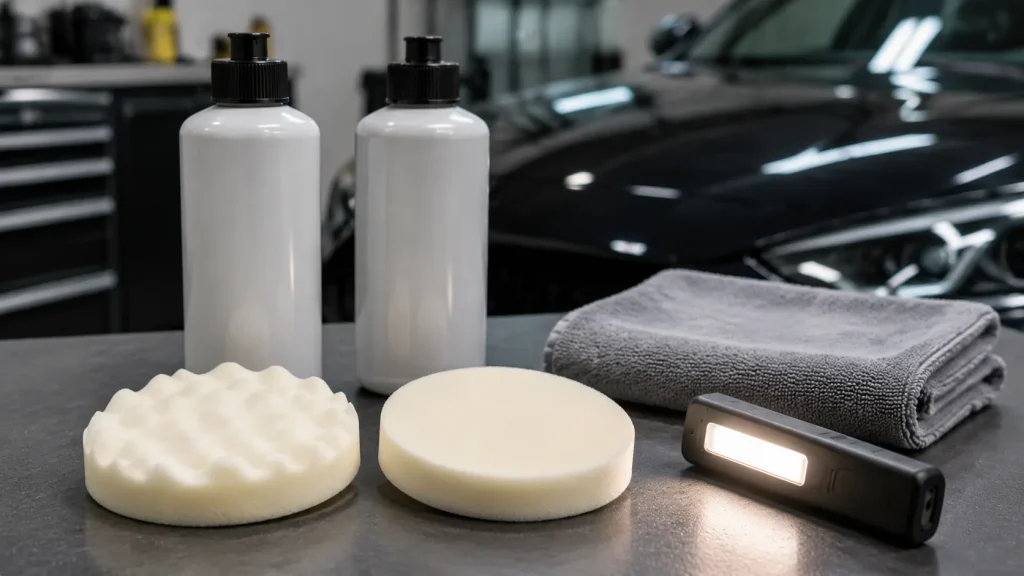
In common car-detailing use, a compound usually targets stronger defect correction, while a finishing polish usually targets finer defects and final clarity. Both can contain abrasives and remove paint material. The distinction is their intended role within a system, rather than a universal dividing line between two kinds of liquid.
Choose from the condition of the paint and a test spot. If a mild polish-and-pad combination produces an acceptable result, there is no reason to compound the whole car first. If stronger correction is justified, assess its finish before deciding whether a separate polishing stage is needed.
This guide covers intact conventional gloss paint. It is not a procedure for matte finishes, film, failing clear coat or repairing deep scratches. For machine use, follow the approved instructions for your equipment, liquid and pad.
Compound vs Polish at a Glance
| Question | Compound, in typical detailing use | Finishing polish, in typical detailing use |
|---|---|---|
| What is its main role? | Stronger correction of suitable defects | Finer correction and refinement of the finish |
| Where might it be considered? | Assessed defects that a milder tested system does not adequately improve | Light marks or refinement after a stronger stage |
| Does it remove material? | Yes, when it is an abrasive correction product | Yes, when it is an abrasive finishing product |
| Will it always finish ready for protection? | No; inspect for haze or fine marks | No universal guarantee; pad, paint and technique matter |
| Does it automatically protect paint? | No | No; check whether the formula explicitly includes protection |
| Does the bottle name define a safe removal amount? | No | No |
“Rubbing compound,” “cutting compound,” “polish” and “one-step” are used differently across product ranges. Read the actual purpose, approved surfaces and method. A product called polish may instead emphasise filling or protection, so confirm that you are comparing abrasive correction products.
Auto Finesse’s guide to polishes and compounds describes cutting and refining as related abrasive processes and shows how mixed-function products complicate the labels. Its named formulas are examples from that brand, not universal instructions for every product.
What Are You Trying to Improve?
Wash and dry the vehicle, then address suitable contamination before judging defects. A rough surface, water-spot deposit, oily residue and a scratch are not interchangeable problems.
| Observation | Sensible starting decision |
|---|---|
| Clean paint looks good and meets your expectations | Skip abrasive correction and maintain suitable protection |
| Fine wash swirls or mild correctable haze | Consider a mild compatible polish-and-pad test |
| More noticeable defects remain after a properly performed mild test | Assess whether a stronger approved system is justified |
| Bonded specks or roughness remain | Identify and remove suitable contamination before choosing an abrasive |
| An isolated deep scratch remains among otherwise acceptable paint | Assess it separately; do not escalate correction across the whole panel automatically |
| Cracking, peeling, exposed lower layers or uncertain repair damage | Seek a repair or experienced paint assessment |
The goal can be a clear improvement rather than complete removal of every mark. A daily driver’s finish does not need to be repeatedly cut until it looks flawless under every inspection light.
Why the Pad Changes the Answer
A compound or polish does not work independently of its pad. Pad construction, cleanliness, machine action, surface condition and technique influence both defect reduction and the finish left behind.
Within an approved system, a liquid may have different roles when paired with different pads. That does not mean any pad can safely turn any liquid into a finishing product. A dirty or loaded pad can also interfere with an otherwise suitable combination.
When comparing polishing pads, confirm the exact intended role and approved machine/plate pairing. Colour is not a universal cutting grade. Check the backing plate as part of that approved combination, rather than assuming that a pad which attaches is compatible. Use separate clean pads for different products and stages so that cutting residue is not carried into the refining step.
How to Choose Using a Test Spot
A test spot helps answer two questions: does the process improve the defect enough, and does it leave a finish you are happy to protect?
1. Establish the paint and its history
Check whether the panel is conventional gloss paint and whether it has previous repairs, correction, coatings or film. Unknown history makes aggressive work harder to justify. Pay particular attention to edges and body lines; an apparently healthy broad panel does not establish the condition everywhere.
A thickness gauge can inform an experienced assessment, but its readings and limitations depend on the instrument and substrate. It does not by itself tell you the amount of clear coat safely available for removal.
2. Begin with a mild approved system
Select a representative test area and a suitable mild combination. Prepare the pad and use the working method specified by the liquid and machine manufacturers. The Griot’s Garage G9 instructions reinforce this least-invasive, test-first principle.
Do not copy speed numbers, pressure or pass counts from another machine. Check your own equipment’s instructions; the advice to test does not transfer a competitor’s numerical settings to your polisher.
3. Inspect after appropriate residue removal
Remove residue with a clean towel and the system’s approved method. Inspect under consistent lighting for improvement, haze and new fine marks. Avoid mistaking oily residue or a temporary filling effect for permanent correction.
If the result meets your goal, keep that combination and inspect periodically as you work. The rest of the vehicle may not respond identically, especially if panels have different repair histories.
4. Escalate only for a clear reason
If the result is inadequate, first check preparation, pad condition and correct product use. When stronger correction is appropriate, test a documented stronger combination and compare the finish. Change one relevant variable at a time so you can understand the result.
Do not keep repeating aggressive cycles simply because a mark remains. At that point the useful decision may be to leave it, obtain a specialist assessment or choose a repair method outside polishing.
When Do You Need a Finishing Step?
After a stronger correction stage, fine haze or micro-marring may remain. A suitable finer pad-and-polish combination may refine that appearance. Test the refining process before applying it to the entire vehicle.
A two-stage process is useful when the stronger stage provides necessary defect reduction but does not leave acceptable clarity. It is not a compulsory ritual for every car. Some suitable combinations can meet the intended result in one correction stage; others may need refinement, particularly on paint that readily reveals fine marks.
Do not decide from the word “compound” alone. Decide from the inspected finish, the product system and the amount of additional work that is justified.
“One-Step” Is Not Always “Clean, Polish and Protect”
One-step can describe completing correction with one liquid-and-pad combination. It does not necessarily mean the product deposits wax, sealant or coating protection.
An all-in-one product may combine cleaning, mild abrasion, filling and protection, but formulas vary. Read which functions it actually provides. If a protection step is required afterward, complete the specified surface preparation and apply a compatible product.
Do not assume every abrasive breaks down in the same way or that every liquid must be worked until transparent. Working cycle, residue removal and application quantity belong to the specific product’s directions.
Know When to Stop
Neither compound nor polish replaces missing paint. Deep damage, a failing clear coat or an uncertain repaired panel may need a different assessment. A fingernail catching a scratch is a reason for caution, not a reliable measurement of whether correction is safe.
Stop machine work if you notice excessive heat, unusual vibration, pad damage, unexpected paint change or uncertainty about the surface. Inspect the system before continuing. Additional pressure or a stronger product is not the default response.
If you are choosing a machine for an approved system, compare the drive types in our DA vs rotary guide and review the model-specific information for FineBuff DA polishers. Accessory approval and technique remain necessary with either drive type. Our 8mm, 15mm and 21mm DA guide also separates orbit choice from pad diameter, which helps avoid choosing accessories from the orbit number alone.
Frequently Asked Questions
Should I use compound or polish first?
For selection, test a suitable mild system first. If stronger correction is necessary, the actual working sequence is generally the justified cutting stage followed by refinement only where needed. The test determines that sequence.
Can polish remove scratches without compound?
It may reduce suitable fine defects with the right system. It cannot repair every scratch, and deeper damage should not be chased through repeated polishing.
Do I always need to polish after compound?
No universal rule applies. Inspect after compatible residue removal. If the stronger stage leaves haze or fine marks, test a suitable finishing process; if clarity already meets the goal, extra abrasion may be unnecessary.
Is rubbing compound safe for a new car?
Newness is not an indication for compounding. Inspect the surface and its history, then justify any correction from actual defects. A mild process or no correction may be the better choice.
Can I compound by hand?
Only with a product approved for hand use and the relevant surface. Hand application does not make an abrasive harmless, and results may be limited or uneven. Start with a small test and follow the directions.
Do I need wax after polish?
A conventional correction polish does not automatically protect the paint. Follow the chosen wax, sealant or coating system after the required preparation. An all-in-one may already leave protection; check its instructions.
Request a Quote
Sourcing pads or polishers for a workshop, distribution range or private-label project? Review our OEM / ODM options and contact FineBuff with the product URL, intended machine, destination country, estimated quantity and packaging requirements. Ask for the current specifications and approved pad / backing-plate combinations before ordering.
Last updated:
Sources and Further Reading
- Griot’s Garage G9 instruction manual — paint assessment, least-invasive testing and equipment-specific operating guidance.
- Auto Finesse: Car Polishes and Compounds Explained — correction-product terminology and the functions of mixed-formula products.
These are manufacturer references. Their model settings and product-specific claims do not establish FineBuff specifications or universal results.