
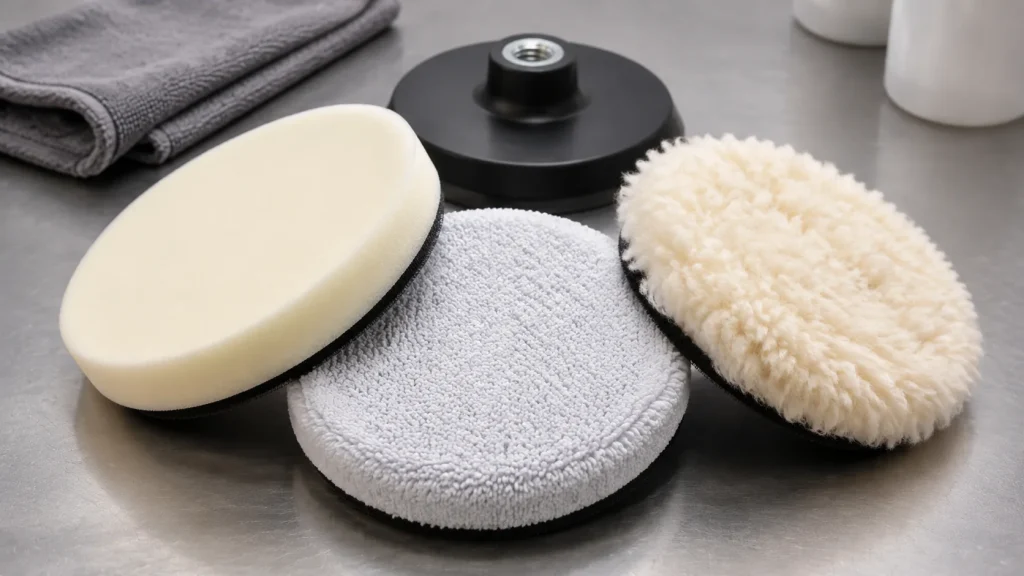
Choose a polishing pad by the task, its compatibility with your machine and backing plate, and the result of a test spot. Material and colour alone cannot tell you how much correction a pad will provide. The liquid, paint, machine action and condition of the pad all affect the result. Auto Finesse’s explanation of polishes and compounds also helps distinguish the liquid’s intended correction role; read that alongside the pad manufacturer’s pairing instructions.
For a beginner working on intact gloss paint with a free-spinning random orbital DA, a manufacturer-approved foam polishing pad and a compatible mild polish can be a sensible test combination. That is a starting point to assess, not a promise that one pad will suit every vehicle or defect.
This guide explains selection principles. Matte paint, wraps, paint protection film, failing finishes and specialist surfaces need separate instructions. Product-specific pad and machine approvals always take priority.
Start by Naming the Job
Before shopping, decide what you want the pad to do. Applying a wax and correcting wash swirls are different tasks, even when both involve a soft-looking round pad.
| Your task | Pad information to look for | What to check afterward |
|---|---|---|
| Apply a machine-compatible non-abrasive wax or sealant | Applicator or finishing pad specifically approved for the product | Even application and clean removal, rather than defect correction |
| Improve light swirls or mild haze | A compatible polishing or finishing combination | Whether the test spot improves clarity without introducing new marks |
| Address more noticeable correctable defects | A documented cutting system appropriate to the paint and machine | Whether the result justifies the additional correction and needs refining |
| Refine marks left by an earlier correction stage | A suitable finer pad-and-polish system | Clarity after residue removal under useful lighting |
Choose the mildest combination that achieves an acceptable result. “Cutting,” “polishing” and “finishing” are useful descriptions within a manufacturer’s range, but they are not universal grades shared by all brands.
Foam vs Microfiber vs Wool Polishing Pads
These materials describe construction. They do not create a reliable global ranking from safest to strongest.
Foam pads
Foam pads come in different structures, firmness levels, profiles and intended roles. A range may include cutting, polishing, finishing and wax-application pads. A soft surface feel alone does not establish the correct use.
Foam can be a straightforward option for learning a documented DA system because manufacturers often offer distinct pads for different stages. Check the pad’s purpose, the suggested liquid and the approved machine action rather than assuming every foam pad is a finishing pad.
Microfiber pads
Microfiber pads use a fibre face, often supported by an interface layer. Some are designed for stronger correction, while others target a different balance of cut and finish. Their fibres need appropriate preparation and cleaning so that residue does not overwhelm the working face.
A microfiber cutting combination may improve defects that a milder foam system leaves behind, but it can also require a refining stage. Do not assume it will finish identically on every paint.
Wool pads
Wool pads vary in fibre construction, pile, interface and intended drive type. Some are designed for rotary correction; others are developed for specified orbital systems. A familiar appearance does not establish interchangeability. Our DA vs rotary polisher comparison explains why identifying the drive type comes before selecting its accessories.
For a beginner, avoid selecting a wool pad solely because it is described as fast cutting. Confirm the machine action, plate and liquid combination first, and assess whether that level of correction is appropriate.
The Griot’s Garage G9 manual lists different foam and microfiber systems and explains choosing a pad and liquid from paint condition. It is a useful illustration of a system-based approach; its accessories and operating settings apply to that machine.
Pad Colours Are Not a Universal Code
A yellow pad from one range may serve a different purpose from a yellow pad made by another manufacturer. Colours help identify products within a particular system; they do not define a common industry cutting scale.
Read the specific label or technical sheet for:
- Intended task and recommended liquid pairing.
- Supported machine actions: free-spinning DA, forced rotation or rotary.
- Compatible backing plate and attachment method.
- Operating limits, preparation, cleaning and replacement instructions.
Keep packaging or record the exact pad name. Buying “another blue pad” is unreliable when several ranges use the same colour differently.
Check Compatibility Before Buying
A pad that attaches to a plate is not automatically approved for the whole machine system.
| Compatibility check | Why it matters |
|---|---|
| Machine action and approved accessory range | A pad designed for one drive type may not suit another |
| Backing plate specified for the pad | The working face diameter and attachment diameter can differ |
| Attachment, centring and backing support | Poor engagement or misalignment can cause vibration or detachment |
| Required clearance and working area | Pad and plate must avoid trim, edges and nearby surfaces |
| Published operating limits | Do not exceed the system’s stated limits or invent a conversion between different motion ratings |
| Machine balance and plate approval | A physically fitting replacement plate may still be unsuitable |
Compare the actual documents for the pad, plate and machine. Do not choose a plate just by measuring the widest part of the pad. The amount of overhang and support must follow the approved combination rather than a universal size rule.
Also keep orbit size and pad diameter separate. A DA’s orbit describes its movement; it is not the pad’s diameter. Our 8mm vs 15mm vs 21mm DA guide explains that distinction. A larger pad is not automatically appropriate because a machine has a larger orbit.
When browsing FineBuff polishing pads, backing plates or DA machines, request confirmation of the exact combination before ordering. A category listing by itself is not a model-specific compatibility approval.
Use a Test Spot to Choose the Combination
Once compatibility is confirmed, use a small representative area to establish the process before treating the whole car.
- Prepare the paint. Wash, dry and address suitable contamination as needed. Work on a cool surface out of direct sun.
- Inspect the pad and plate. Stop and isolate the machine from power before fitting accessories. Check the face, backing and attachment; centre the pad as instructed.
- Prepare the pad with the chosen liquid. Priming and product quantity vary by system; follow its directions.
- Work the test area. Use the machine’s approved settings and handling instructions. Keep the pad controlled and avoid concentrating work on edges or body lines.
- Remove residue and inspect. Use a compatible method and a clean towel. Check defect reduction, clarity and any newly introduced marks.
- Adjust deliberately if needed. Change one relevant variable, then reassess. If a milder process is adequate, use it rather than stepping up automatically.
If the paint history is unknown, defects are deep or the surface appears compromised, get an experienced assessment before increasing cut. A stronger pad is not a solution for missing paint or peeling clear coat.
Plan for Clean Pads, Not Just One Pad
A pad collects used liquid and removed material during correction. A loaded or overheated pad may behave differently from the clean pad that produced your test result.
Have clean, dry spares available. The number needed depends on the working area, pad design, liquid, cleaning method and condition; there is no reliable universal one-pad-per-car rule. Keep separate pads for different liquids and stages to avoid carrying a cutting product into a finishing step.
Stop the machine and isolate its power before removing a pad for inspection or cleaning. Follow the pad manufacturer’s method, keep liquid away from the tool and allow washable pads to dry fully before reuse. Replace pads with damaged faces, separating layers or worn attachment material.
Troubleshooting a Pad Choice
| What happens | What to check before choosing a stronger pad |
|---|---|
| Little improvement | Correct product use, pad cleanliness, machine action, technique and whether the defect is suitable for correction |
| Haze or fine new marks | Contamination, towel condition and whether the combination needs a finer finishing stage |
| Vibration | Stop; inspect centring, attachment, damage and approved pad/plate compatibility |
| Excessive heat, unusual smell or separation | Stop work; allow cooling and inspect the system before reuse |
| Residue becomes difficult to remove | Product quantity, work cycle, surface conditions and pad loading, following the liquid’s instructions |
Frequently Asked Questions
Which polishing pad should a beginner buy first?
A documented, compatible foam polishing system can be a practical starting point for a DA on intact gloss paint. Choose it for the intended job and test it; avoid buying solely by colour or advertised cutting power.
Is microfiber always more aggressive than foam?
No. Construction, liquid, machine action and paint all matter. Compare intended roles within the relevant system rather than treating material as a universal cutting scale.
Can I use the same pad for compound and polish?
Use separate clean pads for separate products or stages. Carrying compound residue into a finishing stage can interfere with the result, and the recommended pad may also differ.
Should the pad and backing plate be the same diameter?
Follow the approved pairing. Pad face diameter, backing diameter and plate diameter are different measurements; neither identical numbers nor physical attachment proves suitability.
How many pads do I need for a whole car?
Enough to keep working with clean, dry, serviceable pads for each stage. Vehicle size, system and pad condition determine the requirement. Prepare spares rather than relying on one pad throughout.
Does a soft finishing pad make any polish safe?
No. The liquid can still contain abrasives, and the machine, paint and technique still affect removal. A finishing pad does not cancel the need for compatibility checks and a test spot.
Request a Quote
Sourcing pads or polishers for a workshop, distribution range or private-label project? Review our OEM / ODM options and contact FineBuff with the product URL, intended machine, destination country, estimated quantity and packaging requirements. Ask for the current specifications and approved pad / backing-plate combinations before ordering.
Last updated:
Sources and Further Reading
- Griot’s Garage G9 instruction manual — paint assessment, least-invasive testing and equipment-specific operating guidance.
- Auto Finesse: Car Polishes and Compounds Explained — correction-product terminology and the functions of mixed-formula products.
These are manufacturer references. Their model settings and product-specific claims do not establish FineBuff specifications or universal results.